BOWOK.
BOWOK.
bowok.dev@gmail.com

Resume download is hidden until the PDF is available, preventing a broken launch link.

Back to Projects

Academic Scheduling System

SIPENTA

Sistem Penjadwalan Terintegrasi Otomatis

An automated academic scheduling system that generates conflict-free schedules while handling complex room, lecturer, time, and building constraints.

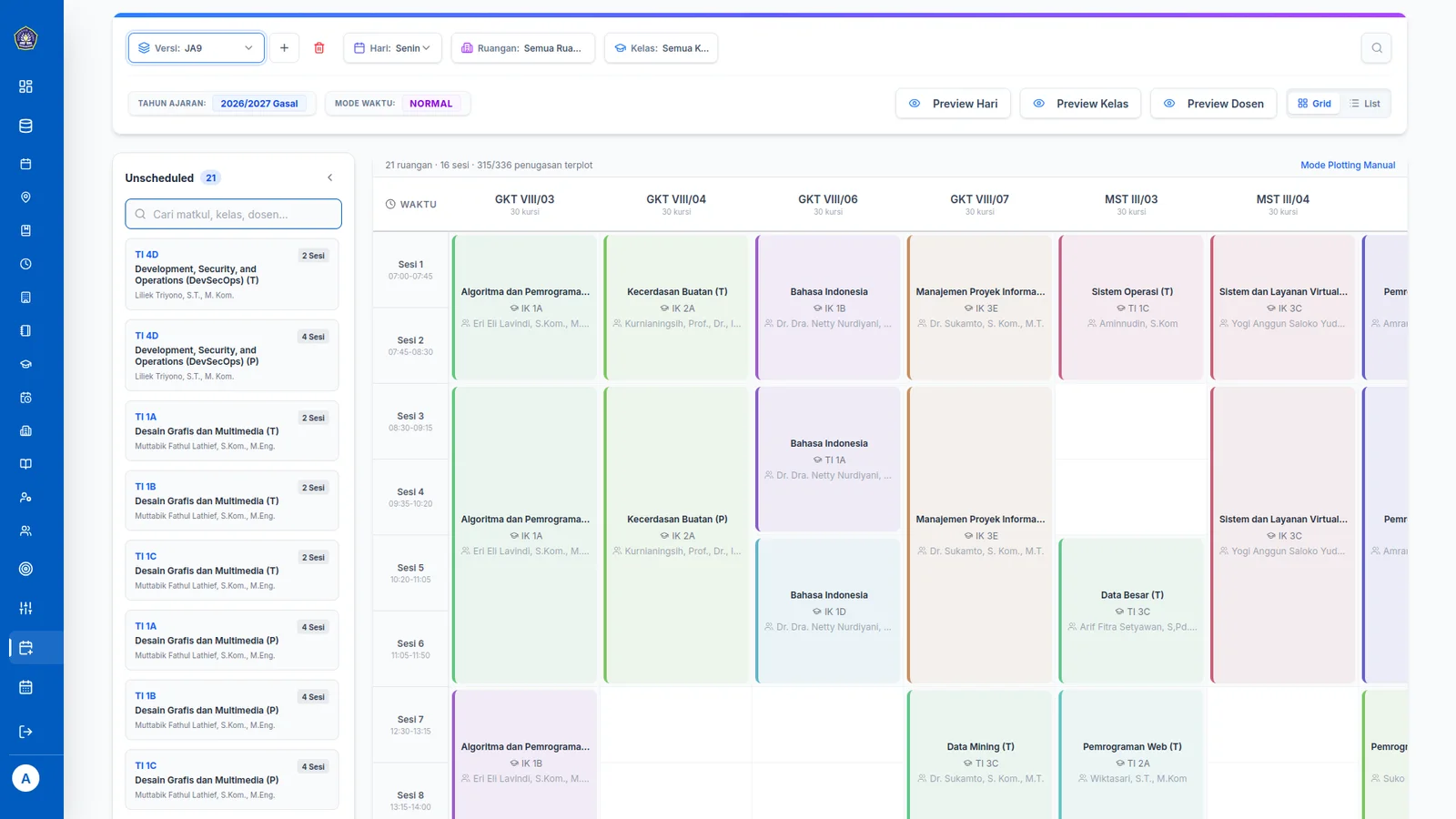
SIPENTA scheduling interface showing unscheduled courses, lecturers, and academic term filters
Completed; planned for institutional use in the following semester

Academic Scheduling System / 2025

Automated academic scheduling workspace

Overview

SIPENTA is an automated academic scheduling system for generating conflict-free schedules from institutional constraints.

The system was built with a larger team of approximately 17 people and later refined by a four-person core group to complete the most important flows.

The Problem

Academic scheduling has to satisfy many constraints at once, including lecturer availability, rooms, classes, time slots, and lecturer movement between buildings.

Goals and Constraints

The goal was to reduce manual scheduling work while respecting lecturer availability, room availability, class needs, course rules, time slots, and movement between buildings.

The project must not expose private institutional datasets or sensitive scheduling rules.

My Role

I worked as technical lead and full-stack developer, contributing across the scheduling logic, application flow, implementation details, and final refinement with the core team.

Solution

SIPENTA turns scheduling constraints into a structured generation workflow, then checks for conflicts so academic schedules can be produced more reliably than manual assembly.

Key Features

Automated generation for academic schedules.

Conflict prevention across lecturer, room, class, and time constraints.

Building-transition awareness for lecturers moving between teaching locations.

Technical Decisions

Next.js supported the product interface and application shell, while Python was used where scheduling logic and constraint handling needed a practical implementation path.

The system treats constraints as first-class inputs instead of relying on manual correction after a schedule is already produced.

Challenge

The main challenge was coordinating many constraints and team contributions without letting the scheduling output become opaque or inconsistent.

Outcome

The system is completed and planned for intended use in the following semester. The copy avoids claiming active deployment until that use is verified.

Reflection

SIPENTA taught me how technical leadership depends on clarity: when constraints, ownership, and integration points are clear, a large team can still move toward a coherent product.